
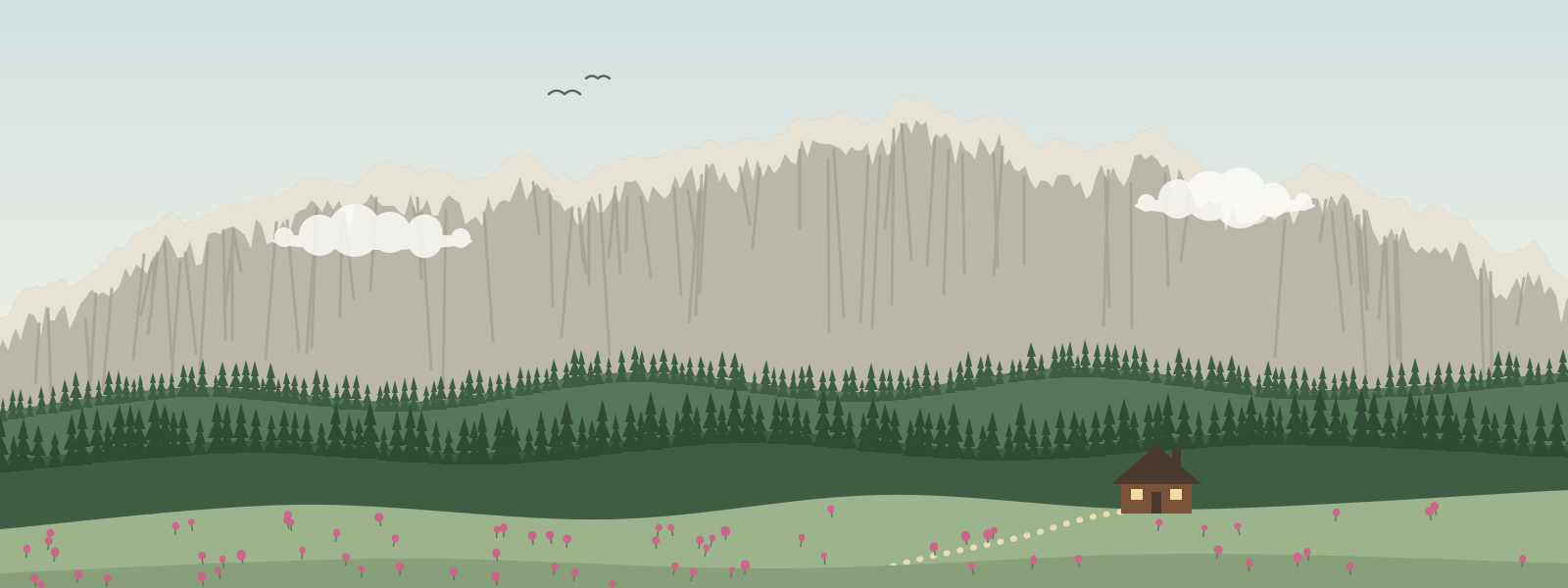
Seen from the meadows near Zărnești, Piatra Craiului looks like a single wave of white stone that froze just before breaking. It isn't a huge range, more a long limestone wall, narrow and sharp, but it has a reputation among Romanian hikers that is out of all proportion to its size. After years of walking around it, I finally spent two days on top of it in the middle of July.
Through the gorge to the hut
We started from the edge of Zărnești on a Friday afternoon and walked in through the Zărnești gorge, a narrow passage between tall limestone walls where the air is noticeably cooler than in town. Beyond it the path climbs through beech and spruce forest and out into open pasture, and in the late light we reached a hut on a grassy saddle below the northern end of the ridge.
That evening was the quiet before the hard part. We filled every bottle we had, because there is essentially no water on the crest, ate a big bowl of soup and went to bed early. The plan was simple: be on the ridge at first light, and be on the way down before the afternoon.
Onto the crest
The climb from the hut onto the ridge is steep from the first step. It gains height quickly through dwarf pine and then onto bare rock, and within an hour or so we were standing on the crest with the sun coming up over the Bucegi to the east and the Făgăraș stretched out along the horizon to the west.
Up there the character of the mountain is obvious. The ridge is often only a few metres wide. On one side the slopes drop away in long screes and gullies; on the other they fall away even more steeply. The limestone is sharp in some places and polished smooth by boots in others, and on the trickier steps there are chains and cables fixed to the rock. None of it is technical climbing, but you use your hands often and you have to pay attention all the time. I found I couldn't look at the view and walk at the same time; I had to stop to do either.
Flowers in the rock
For all its harshness the ridge is full of life. Chamois tracks cross the screes, and in July the cracks and ledges are bright with flowers. The one people come looking for is the Piatra Craiului carnation, a small pink flower that grows wild here and nowhere else. We found it in a few places, clinging to the rock where it seemed impossible that anything could grow. We looked, took a photo of the flower and left it exactly where it was.
Watching the sky
Mid-July is thunderstorm season in the Carpathians, and a long, exposed ridge of rock with fixed metal cables is about the worst place to be when one arrives. By late morning the first towers of cloud were building over the mountains. They weren't threatening yet, but they were growing, and we decided not to push on to the far southern end. We reached the highest part of the ridge, a little over 2,200 metres, and then started down one of the descent paths we had studied the night before.
The descent was long, steep and hard on the knees, first on loose stones and then through forest. Just as we reached the trees we heard the first thunder. It rained hard for an hour, and we sat it out under the spruces, wet and very glad we were not still on the ridge.
Practical notes
- Carry all the water you need for the day. I took three litres and drank nearly all of it.
- Start at first light in summer and plan to be off the crest by early afternoon.
- Study the descent routes before you go. Once you are on the ridge the ways down are few, and some of them are steep and loose.
- A helmet is worth considering on busy stretches, where people above you can knock stones down.
- This is a national park. Stay on the marked paths, take your rubbish home and leave the flowers where they grow.