
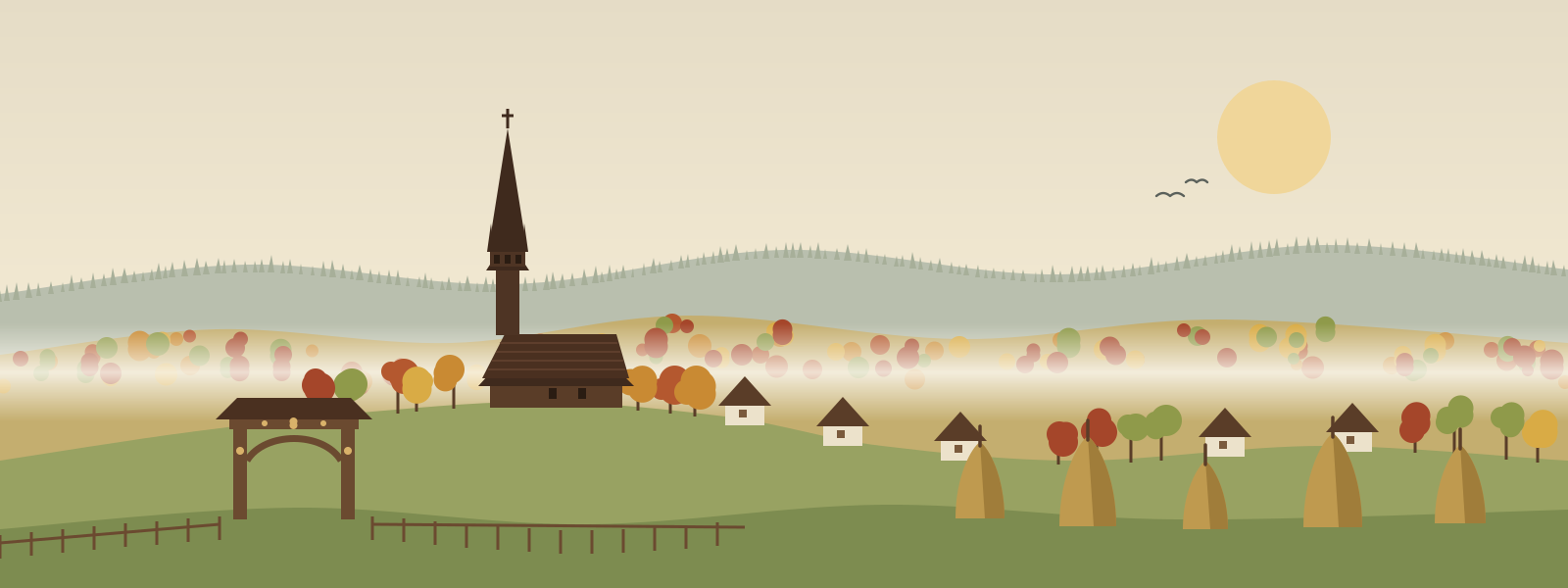
After a summer of rock and ridges, I wanted something gentler. In early October I made the long journey north to Maramureș, a region of valleys and low hills in the far north of the country, known for its wooden churches, its carved gates and a rural life that has changed more slowly here than in most places.
The wooden churches
The churches are the reason most people come, and they are even more striking in person than in pictures. They are built almost entirely of wood, with steep shingled roofs and a single tall, slender tower that rises from the roof like a needle. Seen from across a valley, a village is often just a scatter of roofs among the orchards, with one dark spire standing high above everything else.
Eight of these churches are listed together as a UNESCO World Heritage Site, but there are many more in the region, and some of the unlisted ones moved me just as much. Inside, where you can get in, the walls are covered with old paintings of saints and scenes from the Bible, darkened by many years of candle smoke, and the air smells of wax and old timber.
Being a visitor
These are working churches, not museums. Many are kept locked, and the key is held by someone in the village (the priest, a caretaker, a neighbour) who will usually open up if you ask politely and aren't in a hurry. Twice I was shown around by elderly women who spoke no English at all and explained everything anyway, with great patience, in Romanian and gestures. I left something in the donation box each time.
On Sundays and feast days, services come first. Dress modestly, keep your voice down, ask before taking photographs inside, and if a service is on, either join it quietly or come back later.
Walking between villages
I didn't do any serious hiking this time. Instead I walked from village to village along country lanes and paths over the low hills, anywhere between five and fifteen kilometres a day, carrying only a daypack. In October the hills are wonderful: orchards heavy with apples and plums, beech woods turning copper on the slopes above, and in the fields the tall haystacks built around wooden poles, a shape I had only ever seen in paintings.
The mornings were cold, with thick mist lying in the valleys until mid-morning, and the afternoons were warm and golden. People here still greet strangers on the road, and I had more conversations in that week than in a month in town, most of them about the weather, the harvest, or where I was going and why on foot.
Gates, houses and a cheerful cemetery
Many of the older houses have big carved wooden gates, some of them taller than the house behind them, decorated with twisted rope patterns, suns and trees of life cut into the wood. On my last day I went to Săpânța to see the famous Merry Cemetery, where the graves are marked with brightly painted wooden crosses, each with a small picture and a short, often funny verse about the person buried there. It sounds odd, and it is, but it is also warm and very human, and I liked it a great deal.
Practical notes
- Distances between villages are short, but buses between them can be infrequent. Leave slack in your plans rather than relying on tight connections.
- Village guesthouses are usually simple and welcoming, and the food is homemade and generous. Bring cash, because cards aren't always accepted.
- Autumn mornings can be close to freezing. Pack a warm layer even if the afternoons are mild.
- Village dogs are mostly noise. Walk calmly, don't run, and give them space.
- Ask before photographing people, and inside churches.